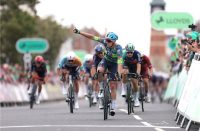
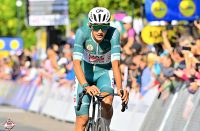
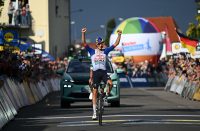

Emirati squad will make its first appearance at the longest stage race outside of cycling’s three Grand Tours, with a prologue and 10 stages in the route
Tuesday 4 August, 2026
For the first time in the team’s history, UAE Team Emirates-XRG will line up at the historic Volta a Portugal em Bicicleta. Raced for almost two weeks from Wednesday, 5 August to Sunday, 16 August, the Portuguese event is the longest stage race outside of cycling’s three Grand Tours.
Beginning with a prologue and including a rest day midway through the race, the Volta a Portugal also features 10 road stages and will host its 87th edition this year.
The 2026 instalment spans a whopping 1429.9km and holds more than 24,000m of elevation gain across its 11 days of racing. For UAE Team Emirates-XRG, the race provides a perfect opportunity to field a squad combining both youth and experience, led by Sports Directors Aner Moreno and Giacomo Notari.
From the WorldTour ranks, Luca Giaimi, Julius Johansen, Rui Oliveira and Adrià Pericas will all feature, with the seven-man squad completed by the Gen Z talents Abdulla Jasim Al-Ali, Marcos Freire, and Jaime Torres.
For Oliveira, the race will mark a special moment for the Porto native, with the Portuguese rider making his first career appearance at the Volta a Portugal.
Indeed, only Johansen has raced this event in the past, with the Danish rouleur claiming three top-10 finishes in his appearance in 2024.
Leading the team’s general classification hopes, Pericas will make his first showing since finishing inside the top 10 at the recent Sibiu Cycling Tour. The young Spaniard is only improving as his first season in the WorldTour ranks unfolds, and stages 4 and 9 will be particular targets for the 20-year-old.
As for the route itself, the 87th Volta a Portugal begins with a city-centre prologue in Lisbon on Wednesday, 5 August. At 6.5km long, this test against the clock is longer than previous prologues we have seen in the season, but should be no less intense. An initial ranking of the general classification contenders will be provided, and the first leader’s jersey awarded.
From here on out, the road racing is on from Lisbon to Porto, spanning 11 days and 10 stages.
Stages 1 and 2 will run from Lourinhã to Queluz and from Sines to Albufeira, respectively, before the longest day of the race on stage 3. Spanning 182.2km between Beja and Elvas, stage 3 is competed over rolling terrain that should favour opportunists.
From opportunists to bona fide contenders, stage 4 provides the first mountain tests. From Figueiró dos Vinhos to Covilhã (Torre), the peloton will face 4,040m of climbing across just 154.6km of racing. Torre, the highest point of mainland Portugal, lies within the Serra de Estrela and rises for 22km at 6.3%.
The final 6km to the finish line harbour an average gradient of over 7%, providing a perfect battleground for the GC contenders to lock horns.
Their dispute will continue on Monday’s stage 5, 10 August, with an individual time trial held between Anadia and Águeda. Raced over 17.4km, this ITT is not technical in its nature, but has enough climbing to catch out those riders with sore legs from the previous summit finish.
The following three stages each contain more than 2,000m of climbing, adding to the relentless nature of this year’s Volta a Portugal. First, however, the race will enjoy a rest day on Tuesday, 11 August.
Beginning once more on Wednesday, stage 6 will run from Santa Maria da Feira to Peso da Régua. The day’s honours should belong to a sprinter, should the teams of the fast men keep a potential breakaway in check.
Up and down all day, stage 7 between Vieira do Minho and Gerês will task the riders with 3,188m of climbing. The puncheurs will fancy their chances on an uphill kick which stands at 4% for 4.6km, from the banks of the Rio Gerês to the centre of town.
Continuing to the north of Porto, stage 8 will certainly prove another tough day in the saddle. Spanning from Melgaço to Fafe, the first 50km are completely flat but precede a succession of challenging climbs.
On the outskirts of Guimarães, the category 3 Penha climb stretches out for 6.2km at 6%, topping out with just 14km to ride. This should provide ample terrain for attacks and ambushes, preceding a 2km-long uphill kick to the line in Fafe.
Held on Saturday, 15 August, stage 9 is billed as the Queen stage of this year’s Volta a Portugal, with well over 3,000m of climbing to be had.
Beginning in Paredes, stage 9 will feature an unprecedented double ascent of the Senhora da Graça (Monte Farinha). The peloton will first summit the climb from the northern route of Carvalhais, before taking the western approach, with its spiralling hairpins, for the second and final ascent to the finish line.
The final climb averages 7.4% for 8.3km, and the toughest test is reserved for last. The final kilometre will be raced across an old dirt road that will take the winner-in-waiting to the doors of the Nossa Senhora da Graça Sanctuary. It will be here, at the summit of the Queen stage, that this year’s overall winner will be known.
To end the race, stage 10 will be held between Maia and Porto on Sunday, 16 August. As is customary for the final day of a long stage race, the 136.9km-long stage will be mostly ceremonial, taking the race into the centre of Porto for an expected bunch sprint.