
Key points:
Tadej Pogacar was the first rider to win La Vuelta’s white jersey.
In 2019, making his Grand Tour debut at the age of 20, he finished third –his “worst” overall result in a three-week race– and won three stages.
On the penultimate day, he impressed Eddy Merckx in the Sierra de Gredos.
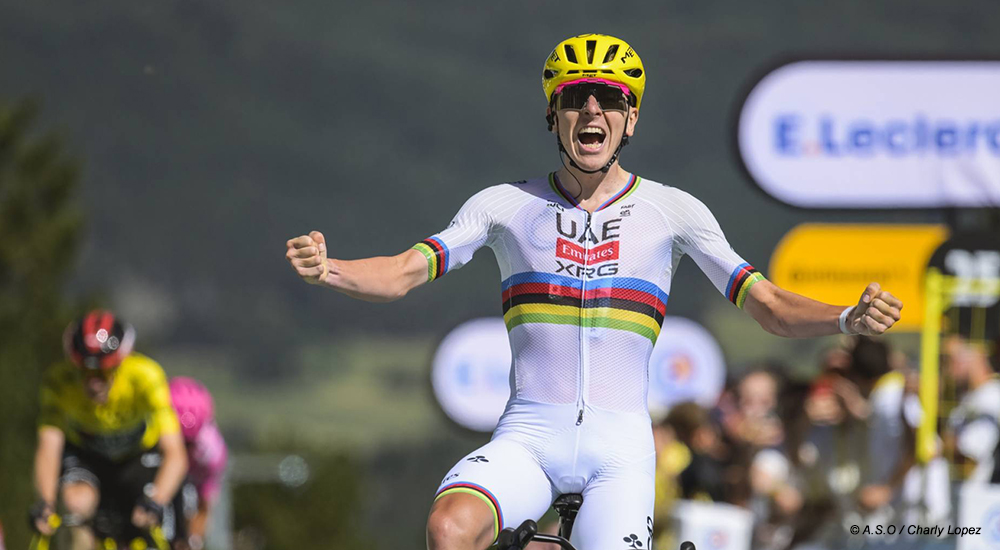
A five-time Tour de France winner (2020, 2021, 2024, 2025 and 2026) and two-time runner-up (2022 and 2023) as well as Giro d’Italia champion (2024), Tadej Pogacar is yet to add La Vuelta to his list of Grand Tour victories. That’s why he lines up this weekend in Monaco for his tenth Grand Tour, aged 27. Yet the Spanish race is the one that launched him on his quest to conquer three-week races.
The Slovenian prodigy, winner of the Tour de l’Avenir 2018, was not supposed to ride any Grand Tour in his first professional season. Joxean ‘Matxin’ Fernandez, his sports director, had drawn up “a career plan that we had established together, with 65 to 70 racing days in 2019, then either the Giro or La Vuelta in 2020, depending on his choice, and the Tour de France in 2021, to see how he would do before tackling the race ambitiously in 2022. But he is a champion! He progressed so much faster than expected that we adjusted the plan.” His victory at the 2019 Tour of California sped up the process. He was so young that the organisers denied him the traditional champagne celebration, as alcohol was prohibited for anyone under 21 in the United States.
La Vuelta 19 featured three former winners at the start in the salt flats of Torrevieja: Alejandro Valverde, Nairo Quintana and Fabio Aru, alongside whom debutant Pogacar was supposed to learn with UAE Team Emirates. But things got off to a very bad start for the Emirati squad, which finished second-last in the opening team time trial won by the Astana team of Colombian Miguel Angel “Superman” Lopez! The overwhelming favourite for that Vuelta was Primoz Roglic, third in the Giro but yet to win a Grand Tour. In its preview of the race, El Pais called for “a young and audacious winner”, naming “Superman Lopez, (Sergio) Higuita or Pogacar”.
For the first time in its history, La Vuelta awarded a white jersey, like the other two Grand Tours, to the best rider under the age of 26. In 2017 and 2018, the best young rider was awarded a red bib. Before that, a secondary classification for the best neo-professional, regardless of age, had existed on ten occasions: in 1970 and from 1984 to 1992. Already a winner in 2017, Lopez was considered the favourite, ahead of fellow Colombians Dani Martinez and Sergio Higuita, Britons Hugh Carthy and Tao Geoghegan Hart, Spain’s Oscar Rodriguez, “and the Slovenian phenomenon Tadej Pogacar”, according to a press release from the organisers.
Pogacar and Roglic at La Vuelta 19
© Unipublic / Sprint Cycling Agency
‘Pogi’ pulled on his first white jersey in Mora de Rubielos, Aragon, at the start of Stage 6, but by proxy, as Lopez was wearing La Roja since the opening day. The following day, he conceded 51 seconds to Valverde, winner with his rainbow jersey on the brutally steep Mas de la Costa. The Spaniard was the oldest rider in the peloton and the Slovenian the youngest. Frenchman Nicolas Edet was wearing La Roja, and Lopez the white jersey, when Pogacar claimed his first Grand Tour stage victory, on Stage 9 at Cortals d’Encamp in Andorra. A place that will stir memories on the fourth day of this year’s race, in the Pyrenean principality.
It was time for the media to get to know him. This was how he introduced himself on the rest day: “My name is Tadej Pogacar. I come from Slovenia. It is a small country where people are hard workers. I started cycling at the age of nine to be like my older brother, because everything he did, I absolutely had to do too. He stopped cycling, but I didn’t. I have never stopped improving and, to this day, I am very happy with what I have achieved.”
Pogacar winning at Cortals d’Emcamp, his first victory in a Grand Tour
© Unipublic / Sprint Cycling Agency
At the halfway point, the die was cast, with Roglic holding a 1’52” lead over Valverde after the time trial in Pau. Pogacar was fifth, 3’05” down. At Los Machucos, a steep climb in Cantabria (Stage 13), the two Slovenians arrived together, with Pogacar winning the stage and becoming the best young rider in the overall classification for the first time. But Lopez moved back ahead of him at Becerril de la Sierra (Stage 18), and Pogacar was only fifth, 1’18” off the podium, in the morning of the penultimate stage going to Plataforma de Gredos. He was, however, wearing the green jersey, as Primoz Roglic, Sam Bennett and Alejandro Valverde, the riders ahead of him in the points classification, had other distinctive jerseys to wear. Not scared by the 4,500 metres of elevation gain, nor by the rain and wind, the strong breakaway or Astana’s efforts to edge out Quintana from the third place and Valverde from second, Pogacar attacked 38km from the finish and finished 1’32” ahead of the world champion who came second.
“I think I need a few days to understand what I’ve done,” ‘Pogi’ said in the flash interview. Watching the race live on television, Eddy Merckx, the greatest cyclist of all time, immediately understood that the moment was historic. “That day, I knew we were dealing with an exceptional champion,” he has repeated ever since.
Between the First World War and La Vuelta 19, only three riders had stood on a Grand Tour podium before celebrating their 21st birthday: Fausto Coppi, winner of the Giro in 1940; Antonio Jimenez, runner-up in La Vuelta in 1955; and Giambattista Baronchelli, Merckx’s runner-up in the 1978 Giro. Until then, only one rider had won three stages of a Grand Tour before turning 21: Giuseppe Saronni at the 1978 Giro – but those were not three mountain stages.
In La Vuelta 19, Pogacar paved a new way, for himself and for a new generation of young prodigies that are now trying to challenge him.